



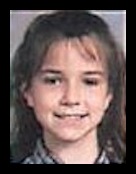
Candace Newmaker
Victim of Attachment Therapy
Durham, North Carolina
Killed April 18, 2000, at age 10, in Evergreen, Colorado
Note: The following account has been prepared from press reports, personal interviews, trial transcripts, and other public records. See the webography for some of the extensive news coverage of the case.
Two Attachment Therapists in Colorado were found guilty by a jury of reckless child-abuse resulting in the death of 10-year-old adoptee Candace Newmaker during a “rebirthing” session. Both are appealing their convictions, but have begun serving historic 16-year sentences in Colorado state prison.
Connell Watkins, a pioneer in the treatment of “Attachment disorder” in children, and her associate, Julie Ponder, a marriage and family therapist from California, were convicted after a grueling three-week trial.
Two assisting “therapy parents,” Brita St Clair and Jack McDaniel, originally faced identical charges, but in a plea bargain made after the others’ convictions, pled guilty to lesser felonies for negligent child-abuse and received 10 years’ probation and a thousand hours of community service.
Jeane Elizabeth Newmaker, upon her arrest
for criminally negligent child abuse. In a plea
bargain, she pled guilty and was given a deferred
sentence of four years. The nursing board in
North Carolina permitted her to keep her
registered nursing license, though state law
sees a guilty plea to child abuse as
sufficient cause to revoke it.
[Photo: Rocky Mountain News]
For her role in the fatal session, Candace’s adoptive mother, Jeane Newmaker, also faced the lesser charge of negligent child-abuse carrying a possible 4 to 16 years of jail time. In another plea bargain, she was able to get a minimum sentence of 4 years. The sentence was deferred for 4 years, effectively making it probation, though at the end of the term, her official record will be cleared of the charge.
Watkins was also convicted on a related second felony, criminal impersonation, and on two misdemeanors—obtaining a signature by deception and unlawful practice of psychotherapy. The sentences on those lesser counts were to run concurrently, and have been served.
After the three-week trial in which they twice viewed a 70-minute videotape of the “rebirthing” therapy session that took place on 18 April 2000, jurors deliberated about five hours to find Watkins, 54, and Ponder, 40, guilty of reckless child-abuse resulting in death. The two women sat motionless while Judge Jane Tidball read the verdict, but broke down in tears when they were led away in handcuffs.
Candace’s grandmother, Mary Davis, who with her husband attended the latter part of the trial, had no pity for the therapists. “They weren’t crying tears for Candace, they were crying tears for themselves,” she said.
Connell Jane Watkins
An acolyte of one of the earliest Attachment Therapists,
Watkins gained nationwide prominence and reputation in AT circles,
along with an unshakeable belief in her own abilities and judgment,
to the exclusion of all others. She might change her surname to “Cooil”
after finishing her sentence in 2017. She is already
referred to in one AT book as “C. J. Cooil.”
[Photo: Rocky Mountain News]
The convictions came almost a year to the day after a video camera recorded the four Colorado therapists killing Candace, while Jeane Newmaker, a pediatric nurse practitioner from Durham, NC, watched. The therapists required Candace to assume a fetal position on the floor, wrapped her in a flannel sheet, piled over a dozen thick pillows, and pushed against the 75-pound girl with a combined weight of 673 pounds. At one point, the adults can even be heard grunting with effort.
In a voice filled with panic, Candace repeatedly screamed that she couldn’t breathe, couldn’t move, and couldn’t find the way out. Her struggle was so intense that she kicked a 31-inch tear in the sheet with her stocking feet. In time her protests got weaker and eventually only labored and irregular breathing could be heard from her. Fifty minutes into the session, Candace went completely quiet. The therapists taunted her with “quitter, quitter, quitter” and sat on top of her for another twenty minutes before unwrapping the sheet. Candace was discovered blue and lifeless. Paramedics called to the scene were able to coax a heartbeat from her, but her pupils were fixed and dilated. She was pronounced dead the next morning from cerebral edema.
“I hope this sends a clear message that children should not be treated that way in the name of psychology or psychotherapy,” Jefferson County prosecutor Steven Jensen told the press after the verdict was announced. Jensen and Laura Dunbar were the team from the Jefferson County District Attorney’s office that made this historic case against Watkins and Ponder resulting in therapists being sent to prison because of the type of therapy they used.
The jury had been emotionally affected by what they saw and heard in the courtroom. “We do definitely love Candace. She is in a better place now. She can experience love,” juror Jim Ball told Candace’s grandparents.
The two therapists, who operated out of Watkins’ Evergreen, Colorado, home, labelled their treatment of Candace as “rebirthing,” though it was in reality just a script to be used in a holding session typical of Attachment Therapy (AT). The label has nevertheless stuck to the entire incident, and it has become widely known as the Rebirthing Case. Watkins and Ponder had been taught this style of AT by Douglas Gosney, a California marriage and family therapist, as he passed through Colorado in 1999. (Gosney, a follower of William Emerson, has discussed using coercive restraint as therapy; he also has claimed, like a number of Attachment Therapists, that memories of trauma can be repressed and stored in cells outside of the brain. He uses stop-frame videos to show where and what kind of birth traumas are stored in the body. Gosney went on to become a Post Institute certified therapist.)
The rebirthing was an attempt to regress “unattached” Candace back to the time of her birth by re-inflicting the physical distress of the birth process. Experiencing this trauma is supposed to recover repressed memories of the original horror of birth: the pain of contractions, the supposed suffocating passage through the birth canal, and the struggle to be born. By the end, in confronting the trauma, a child is supposed to be reduced to an infantile state and accepting that she is “helpless” and “hopeless” without the mother. So when she exits the flannel womb, she is able to trust, love, and surrender authority to her hopeful mother waiting nearby. Mother and daughter could then begin anew the process of attachment by re-living Candace’s early childhood development.
Or so it was supposed to happen — in theory.
Julie Lynn Ponder
Nominally the leader of the fatal rebirthing session,
she was the only licensed therapist in the room that day.
She had been issued her Marriage and Family Therapist
license from California just ten months
before the killing. It was revoked a year
after her conviction.
[Photo: Rocky Mountain News)]
The fatal session, and many hours of more typical AT holding sessions, had been videotaped as a matter of course by Watkins. The videotapes were shown at the trial to a packed courtroom. Many viewing them were moved to tears by the treatment Candace received. The tapes have since been sealed by the judge in the case, for “privacy” reasons.
The tape showed Watkins and Ponder instructing Candace to try to come out of her flannel “womb” and then frustrating her efforts to comply. They blocked her movements, retied the ends of the sheet, shifted their weight, and ignored her cries for help. They ignored her pleadings at least 34 times. They continued the session even when Candace complained of nausea, the need to defecate and a lack of air, and even after she urinated. She could be heard vomiting at one point. She specifically said seven times that she felt like she was going to die, once to which Ponder replied, “Go ahead, die right now.” Jeane, her adoptive mother, who was sitting inches away, repeatedly inquired, “Baby, do you want to be reborn?” At the last, Candace weakly replied, “No.” She never spoke again. Shortly afterwards, even her labored breathing could no longer be heard on the tape. Twenty minutes after that, she was unwrapped and discovered to be blue and without a heartbeat.
There were ten more hours of videotapes showing Candace enduring what observers called cruel, degrading, and disgusting practices in typical AT “holding” sessions. In just one two-hour session, for example, Candace had her face grabbed for enforced eye contact 90 times and her head violently shaken 309 times. She was screamed at just inches away from her face 68 times. All the while, Candace was being held in Watkins’s lap, and Jack McDaniel sat on her legs, in what Watkins and other AT proponents call a “gentle, nurturing,” embrace intended, they say, to convey an impression of “safety and love.”
Other “therapy” sessions were all just variations on the same AT theme. In one, Candace’s obese mother lay on top of her or an hour and 42 minutes, and licked her face 21 times. In another, Candace had her treasured long hair hacked off into a short, ragged mop. In still others, she was required to kick her legs in scissors fashion until she was exhausted.
Jack Dudley McDaniel
and Brita Lynn St Clair
en route to arraignments. The two were
married shortly after they were charged for their part in
Candace’s death. During her AT “intensive,” Candace
stayed with them in their “therapeutic foster home.”
Brita trained her as “your basic German Shepherd,”
while “Daddy Jack,” an otherwise unemployed
construction worker, supposedly took
notes as Watkins’s “intern.”
[Photo: Rocky Mountain News]
The AT parenting technique of “strong sitting” (also known as “power sitting”) was in observance. Numerous times, Watkins and others required this naturally energetic 10-year-old to sit absolutely motionless for 10, 20, and 30 minutes at a time. The last image of Candace shown in the courtroom was of her sitting cross-legged, staring blankly at the camera, her face, though still lovely, showing nothing of the smiling, apparently confident girl seen in her fourth-grade class photo.
Two psychologists and a psychotherapist testified for the prosecution that none of the procedures performed on Candace has been shown to be effective. They added that, taken altogether, the treatment appeared to violate applicable professional codes of ethics. One even pointed out that it also appeared to violate the Nuremburg Code on Permissible Medical Experimentation, the standard used at the trial of Nazi doctors after World War II.
During the last week of the trial, Colorado Gov. Bill Owens signed “Candace’s Law” which bans re-enactment of the birth process when it uses restraint that carries a risk of death or physical injury. The bill had been drafted and passed before all the facts about Candace’s treatment had been revealed at trial.
Candace Newmaker led a sad and an unlucky life. She was taken away from her birth mother in North Carolina, allegedly because of abuse, and spent time in five foster homes before she was adopted at age 6 by a single woman, Jeane Newmaker.
The adoptive mother testified that the girl was extremely difficult to handle, had started a fire in her home and abused other children. She said she turned to Watkins as a last resort. The mother’s was the only testimony presented at trial that Candace had significant behavioral problems. Her teachers, neighbors, and even a catechism teacher, saw none of the problems reported by Jeane Newmaker. Doctors accepted the mother’s reports in choosing treatments and assessing progress.
Candace, who may or may not have suffered from emotional problems, had been diagnosed in North Carolina with Reactive Attachment Disorder (RAD), though she did not meet the criteria for that diagnosis when she received it.
A referral led Jeane Newmaker into the world of Attachment Therapy. After just a few months, she went to a national AT convention in suburban Washington, DC, to seek out Bill Goble, a North Carolina Attachment Therapist whom she hoped would take on her daughter. Goble had Newmaker fill out a questionnaire at the convention, from which he was able to say Candace was a “fairly severe” case. However, he said he couldn’t take on another case, and instead referred Newmaker to Watkins in Colorado.
Candace’s treatment by Watkins was part of a “two-week intensive,” common to many AT programs, in which children live apart from their parents and with “therapeutic foster parents” (TFPs). Jeane Newmaker paid up front the $7,000 cost of the program, but many others pay through phony insurance claims. It is not uncommon for children who do not respond to AT to be left for months or years with the therapist and TFPs after the “intensive” for ongoing treatment at a cost of $5,000 to $8,750 a month. Based on evidence presented at the trial, it appears this would have been Candace’s fate had she survived.Angie Elmore eventually gave up
trying to keep her daughter. A little more
than two years after this picture was taken,
Candace had become Jeane Newmaker’s
“attachment-disordered” child who was
unable, or unwilling, to “bond” appropriately.
[Photo: Rocky Mountain News]
During her treatment in Colorado, Candace was repeatedly directed to deny her abusive, uncaring birth mother and accept Jeane instead. “You are letting Angie control your life,” she was told more than once. Angela Elmore, however, had never abused her daughter when she had her. As for not caring for her, that was definitely not the case. (At the time of Candace’s death, Nancy Thomas worked as an associate in Connell Watkins & Associates. Despite this association with Watkins, Thomas continues to be a leading proponent of Attachment Therapy parenting methods. Another associate was Neil Feinberg; Watkins claimed in her defense to be working “under the license” of Feinberg.)
A rural teenage mother, with little education, no job skills and a ne’er-do-well husband, Elmore had run afoul of the North Carolina Department of Social Services (DSS) for allegedly neglecting the welfare of Candace and her two other children. After violating their rules one time too often, the Department decided to take Elmore’s children for good. Angie tried to keep it from happening, and went into hiding with the children in a neighboring county. But DSS tracked them down and put the kids into foster care. Running was not the smart thing to do, but it was not the act of an uncaring mother, either.
At length, DSS decided to terminate the Elmores’ parental rights. Angie fought it for a long time, visiting the kids often, and celebrating holidays with them in a limited way. Eventually, though, a feeling of powerlessness and futility overcame her and she gave up the fight. A local court granted DSS’s motion and Elmore was never to see Candace alive again.
Adoption in North Carolina, as in many other states, is deliberately shrouded in official secrecy. When Candace died, Angela Elmore was not to be told by the state of her daughter’s demise. Indeed, it was not until more than five months later that she was even to learn of it. Reporters for a Denver newspaper, The Rocky Mountain News, followed up on some clues in the official record and eventually learned Candace’s previous identity. These reporters bore the sad tidings to Elmore—and opened up all of Candace’s story to the rest of us.
June 6, 2008: Connell Watkins (aka C. J. Coil) was paroled after seven years in prison to serve out the remainder of her 16-year sentence in a Denver halfway house.
__________________________________________________________________________________________________________
To read more...
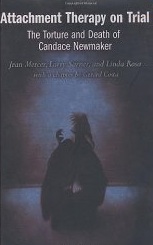
Attachment Therapy on Trial: The Torture and Death of Candace Newmaker by Jean Mercer, PhD, Larry Sarner and Linda Rosa
This scholarly book investigates the entire phenomenon of Attachment Therapy, focused through the lens of the infamous case surrounding the life and death of Candace Newmaker. Published by highly respected academic publisher Praeger, Attachment Therapy on Trial is an unsensational dissection of the pseudoscience, misconceptions, errors, bad judgments, and ethical lapses that has allowed a whole underground industry to thrive around the maltreatment of adopted and foster children. It sounds the alarm about the growth of pseudoscience and unvalidated practices in psychotherapy. And it is a call for action to protect the thousands of children who are not only among the most vulnerable, but also among the most likely, to receive abusive and harmful treatment at the hands of trusted adults — their caretakers and their therapists.
__________________________________________________________________________________________________________
Webography
- Top 50 Notable Cases: Watkins & Ponder Rebirthing Case, Steve Jensen, First Judicial District, 2019. “During the trial, Governor Owens signed into law legislation banning rebirthing therapy in Colorado. Congress also took action condemning the procedure.”
- “Candace Newsmaker: WikiVidi Documentary,” 1 Apr 2018.
- “Evidence of Potentially Harmful Psychological Treatments for Children and Adolescents,” Jean Mercer, PhD, Child and Adolescent Social Work Journal, 15 Dec 2016, 1-19.
- “Attachment Therapy: Candace Newsmaker,” Celtic Counseling blog, 5 Feb 2016
- “Caveat Emptor: Looking Further at Claims by the Institute for Attachment and Child Development,” Jean Mercer, ChildMyths, 28 Jan 2016
- “What Caused Candace Tiara Elmore’s...Death?” Monica Pignotti, Potentially Harmful and Other Equational Therapies, 28 Sept 2010
- “Death by Theory,” Michael Shermer, Scientific American, June 2004
- “Attachment Therapy,” Jean Mercer, The Skeptic’s Encyclopedia of Pseudoscience, Vol 1, 2002.
- “The therapy that killed,” The Guardian, 20 Jun 2001
- Carla Crowder, “Therapist has long ties to ‘holding’ treatment,” Denver Rocky Mountain News, 19 May 2000, pp. 5A,30A
- Rah Bickley, Vicki Cheng & John Sullivan, “Child specialists differ on treatment,” Raleigh News & Observer, 20 May 2000, p A18
- Craig Jarvis, “Girl’s death pains people in Colo. town,” Raleigh News & Observer, 21 May 2000, p A1
- “Type of psychotherapy is under attack after girl is smothered to death,” Reuters News Service, 22 May 2000
- Craig Jarvis, “Rebirthing therapist called gifted, impatient,” Raleigh News & Observer, 23 May 2000, p B1
- Patricia King (with Sharon Begley), “A ‘rebirth’ brings death,” Newsweek, 5 Jun 2000, p 65
- Adam Pertman, “Girl’s death spotlights therapies of desperation,” Boston Globe, 5 Jun 2000, p A1
- Tom Gasparoli, “N.C. psychologist led Newmaker, Candace to Colo., ‘rebirthing’” Durham Herald-Sun, 7 Jun 2000, p C1
- Judith Graham, “Child’s death during treatment casts doubt on new age therapy,” Chicago Tribune, 8 Jun 2000
- Karen Auge (with Kieran Nicholson), “Alternative therapies not new in Evergreen,” The Denver Post, 17 Jun 2000, p 1A
- Karen Bowers, “Suffer the children,” Westword, 27 Jul 2000
- Angie Cannon, “From mumbo jumbo to a child’s death,” US News & World Report, 18 Sep 2000, p 36
- Bonnie Benjamin Skopinski, “Attachment Center struggling to separate self from ‘rebirth,’” Evergreen Canyon Courier, 4 Oct 2000, pp 5A,25A
- Carla Crowder & Peggy Lowe, “Her name was Candace,” Denver Rocky Mountain News, 29 Oct 2000, pp 1M-12M.
- Peggy Lowe & Carla Crowder, “Therapist has strong defenders, foes,” Denver Rocky Mountain News, 29 Oct 2000, p 8M
- Charles Laurence, “Death at rebirth,” London Daily Telegraph Magazine, 4 Nov 2000, pp 48-52
- Jacqueline Casey, “Little girl lost: Rebirth kills grandparents’ hope,” Lincoln Times-News, 15 Nov 2000, pp 1A,8A
- Jacqueline Casey, “Sunday grieving family will finally say good-by,” Lincoln Times-News, 17 Nov 2000, pp 1A,3A
- Jacqueline Casey, “Little girl lost: Grandparents face trial delays in ‘rebirthing’ case,” Lincoln Times-News, 17 Nov 2000, pp 1A,8A
- Cindi Lash, “The death of a new beginning,” Pittsburgh Post-Gazette, 28 Jan 2001, p A1
- Barry Siegel, “Seeking child’s love, a child’s life is lost,” Pittsburgh Post-Gazette, 4 Feb 2001, p A1, A22-A24
- Craig Jarvis, “‘Rebirthing’ spurs change,” Raleigh News & Observer, 11 Feb 2001
- Peggy Lowe, “Birth parents grieve for daughter killed in therapy,” Rocky Mountain News, 25 Mar 2001, pp 5A,11A
- Peggy Lowe, “Video a key piece in abuse trial,” Rocky Mountain News, 25 Mar 2001, pp 5A,10A-11A
- Judith Crosson, “Chilling videotape to ‘star’ in rebirthing trial,” Reuters News Service, 28 Mar 2001
- Jacqueline Casey, “Network films story of girl killed in ‘rebirthing,’” Lincoln Times-News, 2 Apr 2001, pp 1,2
- “Excerpts from video of the ‘birth’ and death of Candace,” Rocky Mountain News, 6 Apr 2001
- Peggy Lowe, “Grueling rebirthing trial enters second week,” Rocky Mountain News, 9 Apr 2001, p 4A
- Kieran Nicholson, “Kin seek justice in rebirth death,” Denver Post, 13 Apr 2001, p 1B
- Sarah Chalmers, “The girl who was loved to death,” London Daily Mail, 14 Apr 2001, p 22
- Michele Ames & Peggy Lowe, “Verdict a relief for family,” Rocky Mountain News, 21 Apr 2001, p 1A
- Michele Ames & Peggy Lowe, “Videotape, flannel cloth convince jury,” Rocky Mountain News, 21 Apr 2001, p 13A
- Kieran Nicholson, “Therapists guilty in fatal ‘rebirth,’” Denver Post, 22 Apr 2001, p 1A
- Karen Rouse & Kieran Nicholson, “Therapy video moved jurors,” Denver Post, 22 Apr 2001, p 1A
- Karen Rouse, “Rebirthing verdict may curb restraint therapy,” Denver Post, 22 Apr 2001, p 3A,12A
- “Therapists paying attention to rebirthing verdict,” Associated Press, 22 Apr 2001
- “Empathetic parents find ‘rebirthing’ verdict justified,” Raleigh News & Observer, 22 Apr 2001
- “‘Rebirthing’ therapists convicted,” Lincoln Times-News, 23 Apr 2001, pp 1A,3A
- Jill Smolowe, Vickie Bane & Michaele Ballard, “Fatal delivery,” People Weekly, 23 Apr 2001, 55(16):125-128
- Grace Bradberry, “Killed in the name of love,” People Weekly, 24 Apr 2001
- Larry Sarner & Linda Rosa, “Colorado rebirthers convicted,” NCAHF Newsletter, March/April 2001, 24(2):1-3
- Bonnie Benjamin Skopinski, “Therapists debate impact of verdict, law,” Evergreen Canyon Courier, 2 May 2001, pp 3A,13A,16A
- Christopher Caldwell, “Colorado rebirthers convicted,” Weekly Standard, 28 May 2001, 6(35):20ff
- Jacqueline Casey, “Rebirthing story to air Friday,” Lincoln Times-News, 13 Jun 2001, pp 1A,2A
- Jacqueline Casey, “Grandparents campaign on ‘rebirthing’ therapy,” Charlotte Observer, 14 Jun 2001, pp 1B,6B
- “‘Rebirthing’ therapist denies guilt,” ABC News, 15 Jun 2001
- Bonnie Benjamin Skopinski, “‘Rebirth’ therapists sentenced to 16 years,” Evergreen Canyon Courier, 20 Jun 2001, pp 1A,17A
- Audrey Gillan, “The therapy that killed,” London Guardian, 20 Jun 2001, p C2
- Christopher Reed, “The cuddles that kill,” Glasgow Herald, 21 Jun 2001, p 17
- Kieran Nicholson, “Rebirthing aides to plead to lesser charges in death,” Denver Post, 2 Aug 2001, pp 1B,8B
- Peggy Lowe, “Two ‘rebirthing’ aides avoid prison,” Rocky Mountain News, 5 Oct 2001, pp 5A,26A
- Peggy Lowe, “No prison for Candace’s adoptive mom,” Rocky Mountain News, 12 Oct 2001, p 26A
- “A new video camera technique,” by Dorothy Mandel, CCHT, and Douglas Gosney, MA, MFCC, APPPAH.
- “Video Reflections: technique and use,” Dorothy Mandel and Douglas Gosney, 1997 APPPAH Conference tapes.
- “Therapist in ‘rebirthing death’ leaves prison,” by Kieran Nicholson, The Denver Post, 1 Aug 2008.
WIKIPEDIA: Candace Newmaker